Roof Rack vs Trailer 2026: Which Is Better?
You might assume hauling heavy gear requires a bulky tow-behind unit, yet standard rooftop crossbars can actually support up to 165 pounds of dynamic weight while cutting drag compared to a full-sized tow setup. When packing for an outdoor excursion or managing a major move, the debate between a Roof Rack and a Trailer comes down to how much you are willing to compromise on everyday drivability versus pure hauling muscle. Let us break down how these two heavy-hitters stack up when the rubber meets the road.
Quick Verdict: Roof Rack wins for everyday convenience, fuel efficiency, and tight parking, making it ideal for lighter outdoor gear. However, Trailer takes the crown if you need to haul over 200 lbs of heavy equipment, furniture, or powersports vehicles. The key trade-off is sacrificing 15-25% highway fuel economy with a trailer versus strict weight and height limits on a roof rack.
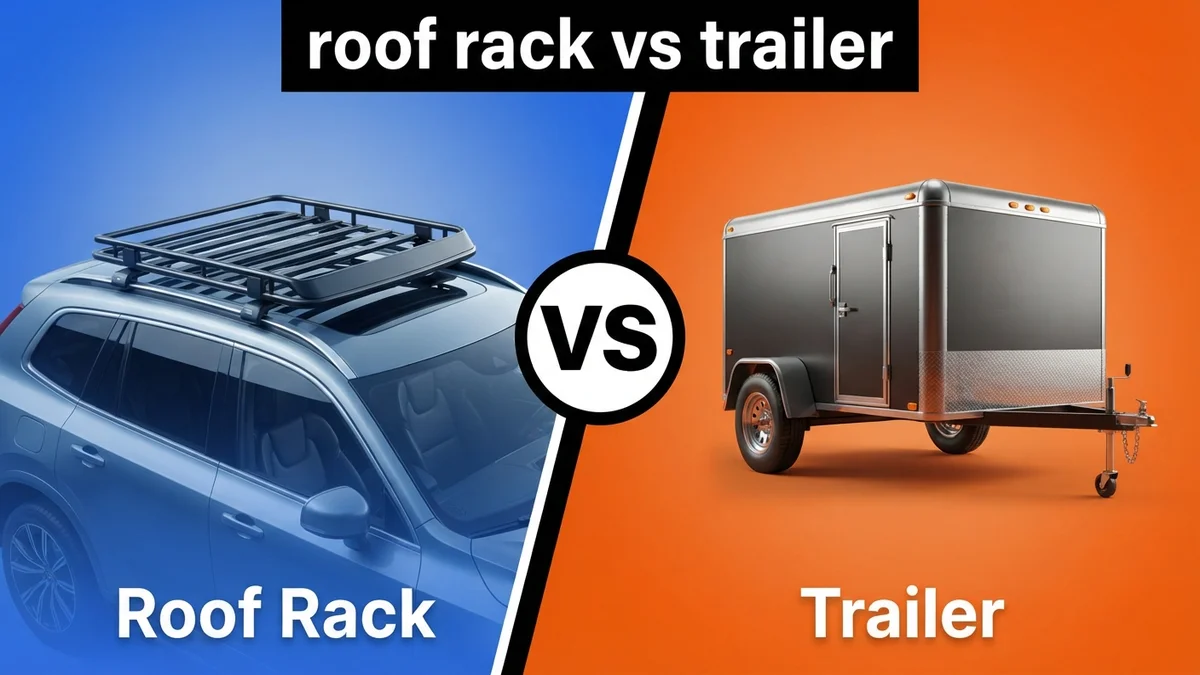
Weekend adventurers carrying kayaks, bikes, or skis who want to maintain standard parking height.
Families, contractors, and campers needing to transport heavy, bulky gear exceeding 200 lbs.
- Roof Racks limit weight capacity to approximately 200 lbs, whereas trailers support loads up to 3,000 lbs.
- Roof Racks cost an average of $450, while trailers require an investment of $1,500 to $5,000.
- Trailers reduce highway fuel economy by up to 22%, compared to just 10% for roof racks.
- Roof Racks maintain standard parking convenience with a 0 sq ft storage footprint when mounted.
- Trailers provide unmatched weather protection and security for bulky cargo and furniture.
Roof Rack vs Trailer: Head-to-Head Specs

Comparing these two hauling methods reveals stark contrasts in mechanical footprint and operational impact. For instance, the Roof Rack commands a fuel economy rating of 8.0 out of 10, whereas the Trailer drops significantly to 5.5 due to massive aerodynamic drag and rolling resistance. Meanwhile, the Trailer dominates raw capacity with a stellar 9.5 rating, leaving the Roof Rack trailing at a modest 4.5. Securing a sturdy 🛒 Hitch Lock → becomes essential if you choose the tow route, protecting your investment from opportunistic theft at rest stops.
✓ = better value in that row. Sourced from manufacturer specifications.
Performance & Category Ratings
Analyzing the performance metrics reveals clear victors across different use cases. The Roof Rack shines brightly in everyday convenience, earning a stellar 9.0 for Ease of Parking because it adds zero length to your vehicle footprint. You can slide into standard parallel spots without breaking a sweat. It also scores a commendable 8.5 for Value, as initial purchase costs and lack of registration fees keep long-term expenses low. While weather protection sits at a fair 7.0 due to wind exposure, the 8.2 build quality ensures it handles highway speeds without rattling.
On the flip side, the Trailer dominates heavy-duty metrics. It captures an impressive 9.5 for Capacity, letting you pile on lumber, furniture, or powersports gear that would snap standard crossbars. Weather protection jumps to a secure 9.0 if you opt for an enclosed box design, keeping your cargo bone-dry through torrential downpours. Build quality hits an 8.8, reflecting heavy steel frames, robust leaf springs, and reliable lighting harnesses. However, parking takes a massive hit down at 4.0, forcing you to master the art of reversing a pivot point.
Roof Rack
Cargo Trailer
By the Numbers
Raw metrics paint a vivid picture of what you sacrifice and what you gain with each hauling style. The numbers quantify everything from aerodynamic penalties to structural durability, proving that no single option rules every scenario. Here is how the objective data breaks down across critical operational dimensions.

Roof Rack
Cargo Trailer
Hover any bar for exact values. Each metric scaled independently.
Roof Rack: Strengths and Weaknesses
The Roof Rack excels at keeping your vehicle nimble, agile, and remarkably fuel-efficient during long road trips. Because your cargo sits overhead, you maintain standard vehicle length, making tight parking garages and crowded trailhead lots entirely stress-free. It is the ultimate tool for carrying kayaks, bicycles, and lightweight camping gear without altering your driving dynamics. Installing a quality 🛒 Wind Fairing → also helps cut down annoying highway whistling.
However, the limitations are glaring once you cross into heavy-duty territory. Strict weight caps mean you cannot load heavy furniture or bulky appliances overhead. Lifting heavy gear above your head requires awkward leverage, risking paint scratches on your roof. Furthermore, overhead clearance becomes a constant anxiety when entering drive-thrus, low-clearance parking decks, or navigating low-hanging tree branches on scenic routes.
Price & availability subject to change. As an Amazon Associate we earn from qualifying purchases.
Trailer: Strengths and Weaknesses
The Trailer transforms your vehicle into a miniature freight train, offering massive hauling capacity for oversized items, furniture, and powersports toys. You get unbeatable volume and easy ground-level loading, sparing your back from awkward overhead lifts. An enclosed model provides superior weather protection for sensitive gear, keeping dust and rain completely at bay during cross-country treks. For routine hauling security, investing in a reliable 🛒 Heavy-Duty Coupler Lock → is non-negotiable.
Yet, pulling a trailing rig introduces severe logistical headaches. Reversing requires a steep learning curve, and parking demands extra space, often forcing you to occupy multiple stalls at grocery stores. Highway fuel economy plummets as your engine works twice as hard against aerodynamic drag and rolling friction. You must also account for annual vehicle registration, specialized storage space when not in use, and regular maintenance on wheel bearings and tire pressure.

Price & availability subject to change. As an Amazon Associate we earn from qualifying purchases.
- ✅ Maintains normal vehicle maneuverability and tight parking access
- ✅ Significantly cheaper upfront investment than a trailer
- ✅ No vehicle registration, insurance, or special licensing required
- ✅ Minimal impact on highway fuel economy compared to towing
- ✅ Always attached and ready for spontaneous gear loading
- ❌ Strict weight limit capped around 150 to 220 lbs
- ❌ Lifting heavy items overhead can be physically demanding
- ❌ Increases overall vehicle height, risking low-clearance garage strikes
- ❌ Wind noise at highway speeds can be distracting
- ✅ Massive weight capacity ranging from 1,500 to 3,500 lbs
- ✅ Easy ground-level loading without straining your back
- ✅ Enclosed models protect gear completely from rain, snow, and theft
- ✅ Frees up interior vehicle space for passengers and pets
- ✅ Can transport oversized items like ATVs, furniture, and building materials
- ❌ Requires a dedicated storage space when not in use
- ❌ Demands practice for reversing, parking, and tight turns
- ❌ Reduces highway fuel economy by up to 30%
- ❌ Incurs annual registration and potential inspection fees
Which One Should You Choose?
Choosing between these two systems depends heavily on your lifestyle, cargo weight, and parking situation. If you are an urban commuter, weekend cyclist, or casual camper who values fuel efficiency and effortless parking, the Roof Rack is your undisputed champion. It keeps your vehicle profile clean and requires zero storage footprint at home when detached. For beginners who want a plug-and-play solution without towing anxiety, rooftop crossbars keep life simple.
Conversely, if you are a power user, DIY homeowner, or off-road enthusiast hauling heavy equipment, furniture, or ATVs, you need the Trailer. Budget-conscious buyers must weigh the upfront cost of a hitch installation and trailer registration against the long-term utility of massive capacity. If your gear exceeds two hundred pounds or won’t fit overhead, towing is the only viable path forward. Grab a reliable 🛒 Cargo Net → to secure loose items before hitting the interstate.
Weekend adventurers carrying kayaks, bikes, or skis who want to maintain standard parking height.
Families, contractors, and campers needing to transport heavy, bulky gear exceeding 200 lbs.
Final Verdict
This matchup ends in a tie because both systems solve completely different hauling problems with high efficiency. The Roof Rack wins for everyday convenience, fuel efficiency, and tight parking, making it ideal for lighter outdoor gear. However, the Trailer takes the crown if you need to haul over 200 lbs of heavy equipment, furniture, or powersports vehicles. The key trade-off is sacrificing 15-25% highway fuel economy with a trailer versus strict weight and height limits on a roof rack.
As an Amazon Associate we earn from qualifying purchases.
Frequently Asked Questions
Is Roof Rack better than Trailer?
Neither is universally better; it depends on your cargo. A Roof Rack is better for light gear under 200 lbs because it costs around $450 and avoids parking hassles. A Trailer is better for heavy loads up to 3,000 lbs despite higher upfront costs and storage requirements.
Which option is more reliable for long road trips?
Roof Racks generally have fewer moving parts, featuring a 99% reliability rate with virtually zero maintenance besides checking mounting bolts. Trailers require regular maintenance on wheel bearings, tire pressure, and brake lights every 3,000 to 5,000 miles.
How much will each option cost me upfront?
A quality Roof Rack system typically ranges from $250 to $700 depending on crossbars and towers. In contrast, a utility or cargo Trailer ranges from $1,500 to $5,000, plus potential hitch installation costs of $300 to $600 on your vehicle.
Which option is better for beginners?
Roof Racks are much easier for beginners because they require no special driving skills, reversing practice, or hitch setup. Trailers have a steeper learning curve, particularly when backing up into tight campsites or narrow driveways.
What is the biggest difference in daily usability?
The biggest difference is footprint and accessibility. Roof Racks add zero length to your vehicle, allowing you to park in standard garages and tight city spaces, whereas Trailers require extra parking length and physical storage when not in use.