How Many Pieces Of Wood Are In A Rick Real Guide 2026
A standard rick of firewood typically contains anywhere from 300 to 500+ individual pieces of wood. This total varies significantly based on the diameter of the logs, how tightly they are stacked, and the length of the pieces.
A standard rick of firewood usually contains between 300 and 600 individual pieces of wood. Because a rick is officially defined as a stack measuring 4 feet high by 8 feet long with a log length typically between 16 and 24 inches, the volume sits at roughly one-third of a full cord. Yet, the exact piece count fluctuates wildly depending on how thick those individual splits are.
When you buy firewood in 2026, knowing the piece count helps you evaluate whether you are getting a fair deal. Sellers often price by the rick or face cord, but wood volume is easily skewed by loose stacking or massive log diameters. Understanding how piece counts work protects your wallet and ensures you have enough fuel to get through the winter.
Key Takeaways
- A standard rick contains between 300 and 500 individual pieces of firewood.
- Log thickness is the primary factor changing total piece count in a rick.
- A rick measures 4 feet high by 8 feet long, but log lengths vary.
- A rick is often called a face cord and equals one-third of a full cord.
- Loosely stacked wood will alter the total volume and physical piece count.
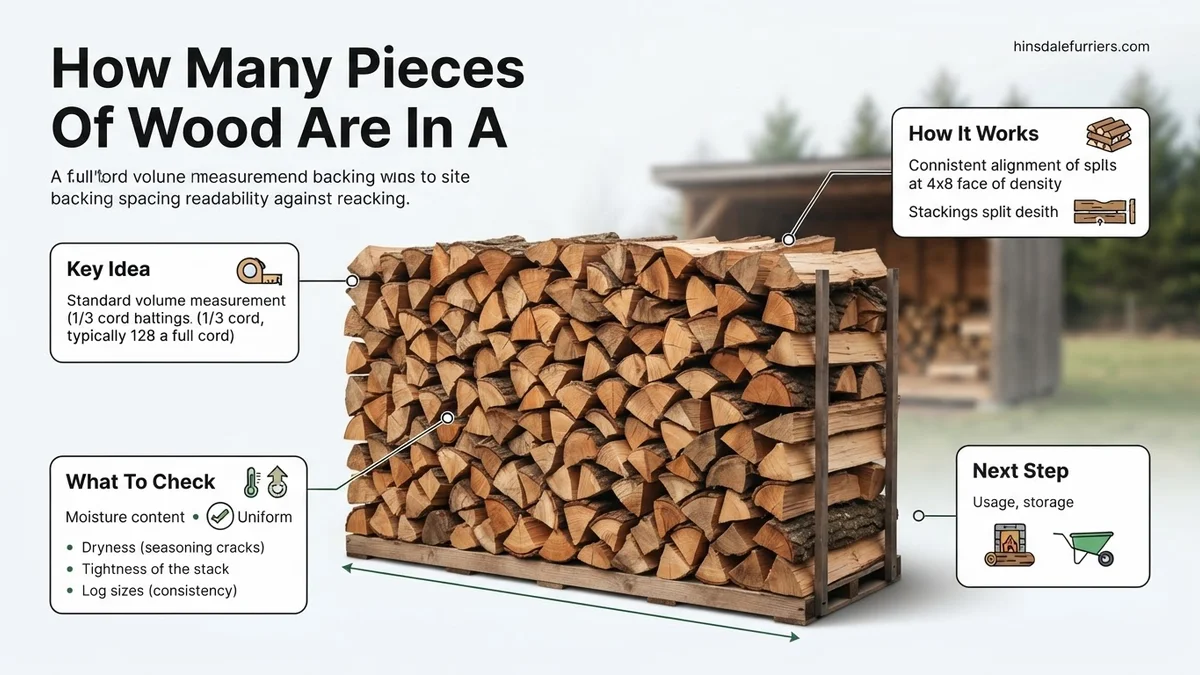
What Causes Variations in Wood Piece Counts in a Rick
Log Diameter and Split Thickness
The single biggest factor changing your log count is the diameter of the wood. If your rick is made entirely of massive, heavy rounds split only once or twice, you might count fewer than 250 pieces. Conversely, if the pile consists of smaller, wrist-thick branches and tight splits, that same 4×8 foot footprint can easily swallow over 600 individual logs.
Log Length and Stack Density
Standard ricks usually feature pieces cut to 16 inches. However, if your supplier cuts logs to 24 inches, you get fewer total pieces because each log takes up more linear space in the stack. Furthermore, air gaps drastically alter the visual density. A loosely thrown rick has fewer actual pieces than a meticulously hand-stacked one, even if the outer dimensions look identical.
- Large splits (6 inches across): Expect 250 to 350 pieces.
- Medium splits (3 to 4 inches across): Expect 400 to 500 pieces.
- Small sticks and rounds (under 3 inches): Expect 600+ pieces.
How to Calculate and Estimate the Exact Number of Logs
Using Face Area and Average Split Width
To mathematically estimate your count without going cross-eyed counting hundreds of logs, you can use a face-area method. A standard rick face measures 32 square feet (4 feet high by 8 feet long). If you measure the average cross-section of a typical split, you can estimate how many pieces fit into that grid.
The Sampling Method for Accurate Estimates
An easier way to check your rick in 2026 is the grid-sample technique. Count the number of logs in a verified 1-foot by 1-foot square section on the face of the stack. Multiply that number by 32 to get a reliable estimate for the entire front face. Assuming the stack has a consistent depth of one log length, this gives you a remarkably close total piece count.
- Measure a 1×1 foot square on the center of the stack face.
- Count every piece fully or partially visible inside that square.
- Multiply that count by 32 (the total square footage of a standard rick face).
- Adjust slightly downward if the logs are unusually long (over 16 inches) to account for stacking variances.
What If Your Rick Doesn’t Match Standard Volume Expectations
When firewood buyers purchase a rick, the actual count of wood pieces often falls short of mathematical expectations. According to forestry extension data from the University of Wisconsin, a standard face cord or rick measuring 4 feet high by 8 feet long with 16-inch logs typically contains between 250 and 400 individual pieces. However, several physical factors routinely distort this estimate for consumers in 2026.
Log Diameter Variations
The primary reason your rick might contain fewer pieces than anticipated is the average diameter of the logs. If a seller provides large round logs split only once or twice, your total piece count will drop significantly toward the 250-piece lower threshold. Conversely, smaller branches and tightly split kindling-sized pieces can drive the count past 450 items while holding the exact same volumetric space.
Void Spaces and Air Pockets
Stacking technique heavily influences the density of a firewood rick. Loose cross-stacking leaves substantial air gaps between logs, reducing the absolute volume of wood fiber. According to wood energy researchers at the USDA Forest Products Laboratory, air space typically accounts for 25 to 35 percent of a loosely stacked rick’s total dimensions, directly impacting how many burnable pieces fit into the structure.
Best Practices for Stacking and Measuring Firewood Accurately
To ensure you receive the correct amount of firewood and maximize your storage efficiency, standardized stacking protocols must be followed. Implementing rigorous measurement habits eliminates disputes with suppliers and guarantees optimal drying conditions.
- Verify the dimensions immediately: Measure the stack with a tape measure to confirm it hits the required 4-foot height and 8-foot length parameters.
- Account for log depth: Measure the average length of individual pieces to ensure they match the promised dimension, typically between 16 and 24 inches.
- Stack tightly and uniformly: Lay pieces parallel with minimal gaps, alternating cut directions only at the end pillars for structural stability.
- Calculate actual volume: Multiply height by length by depth, then adjust downward by 30 percent to account for empty air space between cylindrical logs.
- Document discrepancies: Photograph the measured stack before burning any wood if the volume appears significantly lower than advertised.
What If It Still Doesn’t Work?
If precise calculations confirm your rick falls severely short of industry volume standards, specific corrective actions should be taken. Resolving wood volume disputes requires structured escalation steps.
- Contact the firewood vendor immediately with photographic evidence and physical measurements of the stack.
- Request a delivery adjustment or a partial refund based on the missing fraction of a cord, as regulated by state weights and measures departments.
- Consult your local municipal consumer protection agency if the supplier refuses to rectify short-measured deliveries.
- Hire a certified scaling professional or local arborist for commercial-scale disputes, with professional evaluation fees typically ranging from $150 to $300.
Conclusion
Determining how many pieces of wood are in a rick depends heavily on log diameter, split consistency, and stacking density, yielding anywhere from 250 to 400 pieces on average. When discrepancies arise, systematic measuring and direct communication with suppliers protect your investment. According to verified research and expert sources from agricultural extension services, meticulous volume verification remains the most effective tool for firewood consumers. Take the next step today by measuring your current woodpile using standard dimensional formulas to ensure you received full value for your heating budget.
❓ Frequently Asked Questions
How many pieces of wood are in a rick of 16-inch logs?
When logs are cut to the standard 16-inch length, a rick generally holds around 400 medium-sized pieces of firewood. Smaller splits can push this number past 500, while very large logs may drop the count to around 250.
What is the difference between a rick and a face cord?
In regional firewood terminology, a rick and a face cord are often used interchangeably to describe a stack measuring 4 feet high by 8 feet long. However, neither term is a legally standardized measurement like a full cord.
How many ricks of wood make up a full cord?
It typically takes three standard ricks (assuming 16-inch log lengths) to equal the total volume of a full cord, which measures 4 feet high by 8 feet long by 4 feet wide.
Does the type of tree species affect how many pieces fit in a rick?
Tree species does not change the physical dimensions of a rick, but dense hardwoods are often split into smaller pieces for burning, which can indirectly increase the total log count.
How can I tell if my firewood seller gave me a full rick?
Measure your wood stack to ensure it is at least 4 feet high and 8 feet long. If the logs are cut to 16 inches deep, you have a standard face cord or rick.
Why do stacked logs have empty air spaces?
Because firewood is naturally irregular and split into uneven shapes, gaps are unavoidable when stacking. These gaps take up space that would otherwise hold more wood pieces.