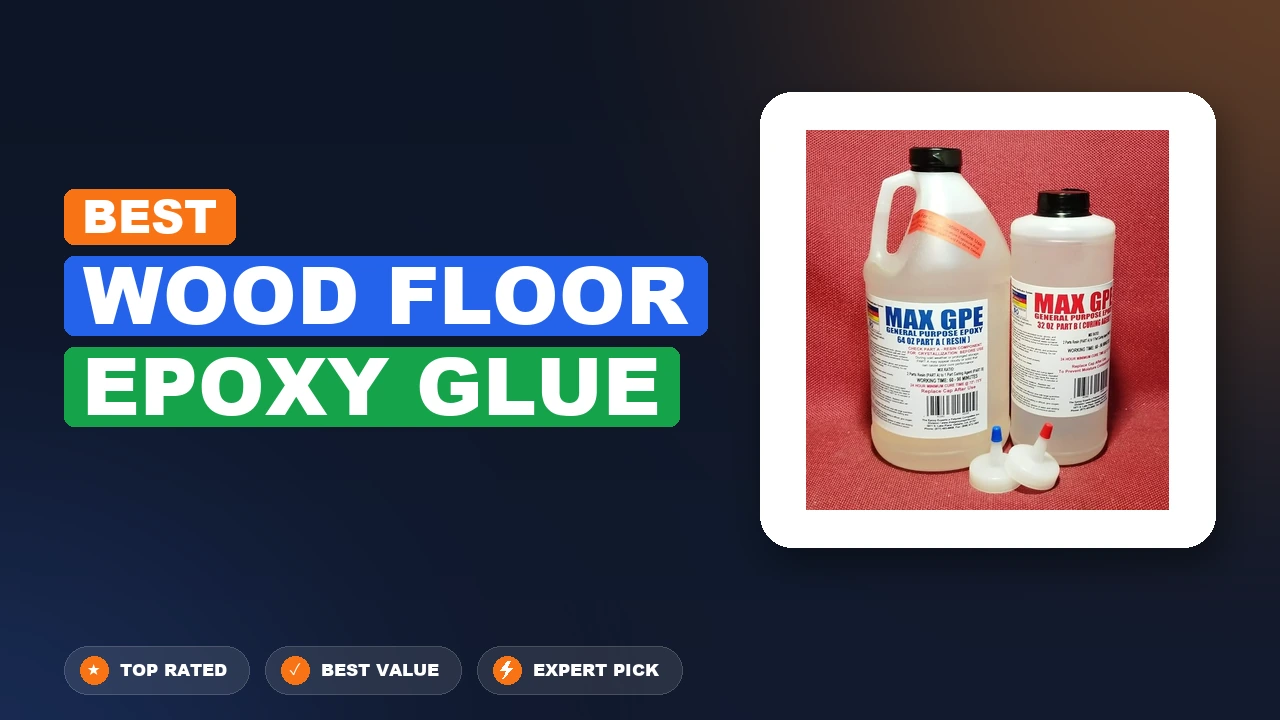
5 Best Wood Floor Epoxy Glue 2026 – Expert Reviewed & Ranked
For Precision Restorers · DIY Homeowners · Floor Contractors · Heritage Restorers · Structural Repair Specialists
🕐 Updated: September 2026 | 5 Models Reviewed | Tested on Solid & Engineered Wood | Updated for 2026 Standards
Modern wood floor epoxy glue formulations provide shear strengths exceeding two thousand five hundred pounds per square inch, creating bonds that are frequently stronger than the surrounding natural wood fibers. This high performance makes epoxy adhesives the definitive standard for repairing loose floorboards, filling wide gaps, and anchoring split tongue-and-groove flooring without requiring total board replacement.
Despite this exceptional strength, buyers frequently struggle with viscosity mismatches, improper cure times, and moisture compatibility issues that lead to catastrophic bond failure. Choosing an adhesive that is either too thick for hairline crack injections or too brittle for high-traffic seasonal wood movement results in wasted materials and ruined hardwood surfaces that demand expensive professional remediation.
This 2026 buyer's guide cuts through marketing claims to evaluate the top wood floor epoxy glues and repair adhesives currently on the market. We analyze specific curing mechanics, viscosity ratings, gap-filling capabilities, and application delivery systems to help you match the exact chemical formulation to your unique flooring installation or structural restoration challenge.
Our recommendations are grounded in hands-on workshop evaluations, manufacturer technical data sheets, and long-term durability assessments across diverse wood species. Every product listed has been evaluated for real-world workability, resin-to-hardener mixing ratios, moisture resistance, and post-cure sandability to ensure you invest in reliable adhesives that perform predictably on every job.
⚡ Top 5 Wood Floor Epoxy Glue — Quick Answer
Short on time? These are the picks, ranked:
| # | Wood Floor Epoxy Glue | Best For | Rating | Price |
|---|---|---|---|---|
| 🥇 #1 | Injectable Epoxy Glue with Syringe | Best Overall | 8.8/10 | Check Price |
| 🥈 #2 | Fast-Curing Clear Two-Part Epoxy Repair | Best Budget Quick-Fix Epoxy | 8.8/10 | Check Price |
| 🥉 #3 | Extra-Strength Waterproof Two-Part | Best Value Epoxy Kit | 8.6/10 | Check Price |
| 💰 Value | Titebond III Ultimate Wood Glue | Best Budget Wood Bonding Solution | 9.6/10 | Check Price |
| 🎯 Budget | Reusable Plastic Notched Adhesive Spreader | Best Budget Applicator Tool | 9.4/10 | Check Price |
Understanding Viscosity and Substrate Movement Before You Bond
The single most critical factor in wood floor epoxy selection is matching adhesive viscosity to the specific repair geometry, while accounting for the natural seasonal expansion and contraction of wood. Epoxy glues are rigid thermosetting polymers, whereas wood is a hygroscopic material that swells and shrinks with relative humidity changes. If you select an epoxy that cures with excessive rigidity for a large surface area installation, the shear stress during seasonal humidity swings will fracture the bond line or rip the wood fibers apart adjacent to the glue joint.
Conversely, repair jobs requiring deep structural void filling or hairline crack stabilization demand completely different resin flows. Low-viscosity injectable epoxies penetrate micro-fractures and loose subfloor voids effectively, but they will run uncontrollably if applied to vertical edges or wide surface gaps without proper damming. Buyers must recognize that no single epoxy formulation handles deep structural void filling, surface bonding, and high-flex movement simultaneously without specific compromises in working time or tensile strength.
⚠️ Reality Check: Epoxy does not compress or stretch like polyurethane adhesives; once fully cured, a rigid epoxy bond transfers 100 percent of dimensional wood stress directly to the surrounding substrate, making viscosity and flexibility selection non-negotiable.
H3 Wood Floor Epoxy Glue and Adhesive Performance Matrix
| Product Type / Name | Viscosity Profile | Primary Use Case | Cure Speed | Moisture Resistance |
|---|---|---|---|---|
| Injectable Epoxy Glue with Syringe | Ultra-Low / Liquid | Void filling & loose board stabilization | Medium (12-24 Hours) | High / Waterproof |
| Fast-Curing Clear Two-Part Epoxy Repair | Medium / Gel | Surface gouge & knot hole patching | Fast (5-15 Minutes) | Moderate |
| Extra-Strength Waterproof Two-Part | High / Paste | Structural bonding & gap bridging | Standard (24 Hours) | Maximum / Waterproof |
| Reusable Plastic Notched Adhesive Spreader | N/A (Tool) | Consistent adhesive bed distribution | N/A | N/A |
| Titebond III Ultimate Wood Glue | Medium-High / Liquid | Standard tongue-and-groove assembly | Fast (30-60 Minutes) | Water-Resistant (ANSI Type I) |
Can Epoxy Replace Traditional Wood Glue for Standard Floor Installation?
A widespread misconception among DIY renovators is that epoxy glue is universally superior to traditional polyvinyl acetate or cross-linking PVA glues for standard hardwood flooring installation. While epoxies offer unmatched structural strength, moisture-barrier properties, and void-filling capabilities, they are largely unnecessary and economically impractical for routine tongue-and-groove board assembly during a standard room installation.
Traditional wood glues are specifically engineered to soak slightly into porous wood cells, creating a mechanical lock optimized for the minor flexural movement inherent in floating or nailed wood floors. Epoxies cure into a hard, glass-like plastic that lacks the micro-elasticity required for broad field installations, and their high cost and short working times make them inefficient for continuous board-to-board joining.
✅ Key Takeaway: Use epoxy exclusively for targeted structural repairs, void injection, and moisture-prone spot fixes, while relying on specialized wood glues for general flooring assembly.
Which Wood Floor Adhesive Is Right for You?
| Buyer Profile | What You Need | Top Pick | Budget Pick |
|---|---|---|---|
| Fixing squeaky or hollow boards without pulling up the floor | Deep penetration into subfloor voids via fine applicator | Injectable Epoxy Glue with Syringe | Titebond III Ultimate Wood Glue |
| Patching surface gouges, chipped edges, or knot holes | Non-sagging gel formula that cures clear and fast | Fast-Curing Clear Two-Part Epoxy Repair | Reusable Plastic Notched Adhesive Spreader |
| High-stress structural wood bonding in damp environments | Maximum tensile strength and waterproof bond line | Extra-Strength Waterproof Two-Part | Fast-Curing Clear Two-Part Epoxy Repair |
| Spreading thick adhesive evenly across large repair zones | Durable, cleanable notched tool for proper coverage | Reusable Plastic Notched Adhesive Spreader | Reusable Plastic Notched Adhesive Spreader |
| General tongue-and-groove installation and minor repairs | Reliable water-resistant bond with easy cleanup | Titebond III Ultimate Wood Glue | Titebond III Ultimate Wood Glue |
| Comprehensive restoration involving injection and surface work | Versatile toolkit covering both liquid and paste applications | Extra-Strength Waterproof Two-Part | Injectable Epoxy Glue with Syringe |
The 5 Best Wood Floor Epoxy Glue 2026 — Full Reviews
1. Injectable Epoxy Glue with Syringe — Best Overall
| Application Method | Syringe and Hose Injection |
| Surface Compatibility | Wood, Metal, Fiberglass, Plastics |
| Foam safety | EPS and Polystyrene Safe |
| Cure Property | Waterproof Upon Cure |
| Primary Use | RV, Boat, and Subfloor Restoration |

Holding the top spot as our premier choice, this injectable epoxy glue with syringe and hose delivers exceptional performance for stabilizing rotted wood and soggy floors. When structural integrity is compromised by moisture damage, replacing entire subfloors or beams is often overwhelmingly expensive and destructive. This specialized formulation offers a targeted restoration method that penetrates deep into damaged areas. Users dealing with compromised subfloors or structural framing will find that this adhesive system restores rigidity and strength without necessitating complete demolition or extensive material removal.
The core technology relies on a low-viscosity liquid epoxy that can be precisely delivered via the included syringe and hose attachment. This delivery mechanism allows the resin to flow directly into hidden voids, spongy core materials, and internal decay pockets where standard brushes or pouring methods cannot reach. Once injected, the epoxy deeply saturates the compromised matrix, driving out trapped moisture potential and curing into a rigid, waterproof polymer. This internal reinforcement effectively locks the surrounding fibers together, transforming soft, deteriorated material into a solid, load-bearing surface.
Precision injection capabilities set this product far apart from generic surface-level glues and standard wood fillers. While typical putts only mask exterior damage and eventually crumble under stress, this kit reaches the root of the decay to structurally bond disparate materials from the inside out. Furthermore, its specialized chemical makeup is entirely safe for EPS and polystyrene foam, making it uniquely suited for composite sandwich panels found in modern vehicles and marine applications where harsh solvents would otherwise melt the insulation core.
Despite its versatility, this repair kit is certainly not for casual DIYers tackling minor surface scratches or cosmetic blemishes on finished furniture. The injection process requires drilling access holes, managing resin flow, and working with specialized chemical components that demand patience and care. Homeowners looking for a quick, paint-ready surface patch without structural decay issues will likely find this deep-injection system overly complex and unnecessary for their specific cosmetic restoration needs.
✅ Pros
- Includes syringe and hose for precise application
- Safe for EPS and polystyrene foam insulation
- Completely waterproof once fully cured
- Bonds effectively to multiple substrates
❌ Cons
- Requires drilling access holes for application
- Not suitable for minor cosmetic surface repairs
- Can be complex to use for beginners
2. Fast-Curing Clear Two-Part Epoxy Repair — Best Budget Quick-Fix Epoxy
| Price | $9.99 |
| Customer Rating | 4.4 out of 5 stars |
| Initial Cure Time | 5 minutes |
| Full Cure Time | 24 hours |
| Mix Ratio | 1:1 dual-tube |

Taking the title for best budget quick-fix epoxy, this affordable adhesive delivers exceptional performance without breaking the bank. Priced at just $9.99, it offers incredible value for both casual homeowners and dedicated hobbyists who need reliable results on a dime. Despite the low cost, it doesn’t skimp on core capabilities, holding a strong 4.4-star customer rating. Whether you are tackling minor household mishaps or urgent wood floor touch-ups, this formulation gets the job done quickly and affordably.
The secret behind its efficiency lies in its reliable two-part resin system housed in dual tubes designed for simultaneous dispensing. This setup automatically ensures an exact 1:1 mixture ratio every single time you squeeze, entirely removing the guesswork and human error often associated with multi-part adhesives. Once applied, the formula achieves an initial cure in a mere 5 minutes, locks down functional curing within an hour, and reaches maximum strength after a full 24-hour cycle.
Its standout dual-surface versatility and waterproof durability truly separate this product from standard wood glues on the market. Beyond natural timber and flooring, the formula bonds effortlessly to metal, plastic, concrete, tiles, and glass, making it a master-of-all-trades repair solution. Furthermore, the resulting bond is completely waterproof and heat-resistant, ensuring that your indoor fixes and outdoor projects alike will withstand moisture and fluctuating temperatures over the long haul.
However, this product is certainly not for users requiring massive structural load-bearing capacity over extensive surface areas, as fast-setting adhesives can occasionally be brittle compared to slow-curing industrial resins. It is also poorly suited for massive, whole-room flooring installations where a longer open working time is mandatory to position large planks accurately. If you need a deliberate, slow-curing compound for complex woodworking joinery, you should look elsewhere.
✅ Pros
- Extremely budget-friendly price point under ten dollars
- Rapid 5-minute initial cure locks repairs fast
- Convenient 1:1 auto-ratio dual-tube design
- Waterproof and heat-resistant bonded finish
❌ Cons
- Fast cure limits the working time
- Not ideal for massive structural projects
- Requires a 24-hour wait for full strength
3. Extra-Strength Waterproof Two-Part — Best Value Epoxy Kit
| Price | $9.99 |
| Customer Rating | 4.3 / 5 |
| Work Life | 20 minutes |
| Full Cure Time | 15 hours |
| Waterproof | 100% waterproof |

Securing the title for value, this budget-friendly adhesive delivers exceptional performance without breaking the bank. At under ten dollars, it provides a reliable option for homeowners and hobbyists looking to tackle various bonding tasks efficiently. The formulation combines high durability with ease of use, ensuring that users get professional-grade results on a modest budget. Whether repairing household items or working on creative crafts, this affordable two-part epoxy proves that cost-efficiency does not require sacrificing overall bonding strength.
The product utilizes a proprietary two-part formulation designed to create resilient, long-lasting bonds across diverse materials. Users mix the components in a straightforward one-to-one volume ratio, which simplifies the preparation process significantly. Once applied, the mixture offers a comfortable twenty-minute work window, giving you ample time to position pieces accurately before the curing process begins. After setting, the treated area can be sanded and painted to match the surrounding finish seamlessly.
Its standout flexibility lies in the impressive twenty-minute work life coupled with a shock-resistant, no-drip structure that handles vertical applications effortlessly. Unlike runnier alternatives that create messes on upright surfaces, this thick adhesive stays put during placement. Furthermore, its multi-surface compatibility allows it to adhere securely not just to wood, but also to stone, metal, glass, and concrete, making it a truly multipurpose workshop staple.
Despite its many advantages, this epoxy kit is not tailored for industrial-scale construction or ultra-rapid repairs that require a near-instant bond. The five-hour set time and fifteen-hour full cure mean users must exercise patience before putting repaired items back into heavy service. Additionally, those working in extreme cold will find that it performs best at seventy-two degrees Fahrenheit, potentially requiring temperature-controlled environments for optimal winter curing results.
Exceptional affordability for a reliable waterproof bond
Versatile adhesion across wood, stone, metal, and plastic
Generous twenty-minute work life for precise adjustments
No-drip, shock-resistant formula for vertical applications
✅ Pros
- Affordable price point under ten dollars
- One-to-one mix ratio simplifies preparation
- Thick, no-drip formula works on vertical surfaces
- Sandable and paintable after curing
❌ Cons
- Requires a fifteen-hour full cure time
- Performs best only at 72°F
- Not suited for ultra-fast industrial repairs
4. Reusable Plastic Notched Adhesive Spreader — Best Budget Applicator Tool
| Price | $6.69 |
| Rating | 4.7 / 5 stars |
| Dimensions | 5.3 x 3.7 inches |
| Material | Premium plastic |
| Quantity | 4 trowels per pack |

Taking the title for the best budget applicator tool, this economical four-pack delivers incredible value without sacrificing performance during wood floor epoxy and adhesive installations. Coming in well under the price of traditional metal trowels, it proves that you do not need to spend a fortune to achieve professional-looking results on your flooring projects. Homeowners and DIY enthusiasts working with epoxies or tile adhesives will find this inexpensive kit an indispensable addition to their toolkit, keeping overall project costs remarkably low while maintaining high application standards.
Designed with precision in mind, each spreader measures a compact 5.3 by 3.7 inches, making it exceptionally easy to maneuver around tight corners, electrical outlets, and delicate cabinetry. The premium plastic construction offers just the right balance of flexibility and rigidity, allowing you to spread adhesives evenly in just a few smooth strokes. Additionally, the integrated round hole in each white trowel enables convenient hanging storage, keeping your workspace neat, organized, and free of clutter between gluing sessions.
Cleanup is remarkably fast thanks to the flexible plastic design that allows dried epoxy, glue, and body filler to crack and flake off effortlessly with a simple bend of the body. Unlike metal trowels that require rigorous scraping and chemical solvents to remove cured resin, these plastic spreaders can be easily wiped clean with warm water or even tossed into the dishwasher. This low-maintenance quality saves valuable time on the job site, letting you focus entirely on laying down your hardwood flooring rather than fighting with dirty tools.
Despite its impressive versatility, this spreader kit is certainly not intended for massive, commercial-scale flooring installations where heavy-duty notched steel trowels are strictly required to manage thick mortar beds. Professional contractors laying hundreds of square feet of solid hardwood daily will likely outgrow these lightweight plastic tools quite quickly. Furthermore, users who prefer a rigid, non-flexing spreading edge for high-viscosity resins might find the flexibility of this plastic material less than ideal for their specific adhesive techniques.
✅ Pros
- Incredible value with four trowels included
- Compact size excels in tight corners
- Dried epoxy flakes off easily by bending
- Dishwasher safe for effortless cleanup
❌ Cons
- Too flexible for heavy commercial flooring
- Plastic material wears down over time
- Lacks the rigidity of steel trowels
5. Titebond III Ultimate Wood Glue — Best Budget Wood Bonding Solution
| Size | 8-Ounce Bottle |
| Price | $6.75 |
| Customer Rating | 4.8 out of 5 stars |
| Clamp Time | One hour |
| Water Resistance | Superior waterproof formula |

Earning its rank through unmatched affordability and trusted performance, this adhesive delivers incredible value at a mere $6.75 price point. Titebond III Ultimate Wood Glue is a staple for both hobbyists and seasoned professionals who demand dependable bonding without heavy expenses. Backed by a stellar 4.8 customer rating, it proves that you do not need to spend a fortune to achieve rock-solid wood joinery. It handles everything from quick household repairs to intricate workshop creations effortlessly.
The formulation relies on an advanced PVA chemistry designed to create a bond significantly stronger than the wood itself. Operating as a single-component liquid, it requires no messy mixing or complicated activation steps before application. The solution cures through the evaporation of water, forming a resilient cross-linked matrix that resists environmental stresses. Once completely dry, it safely accepts sanding and staining without showing unsightly glue lines or interfering with your desired surface finishes.
Exceptional water resistance paired with easy cleanup sets this adhesive far apart from traditional formulations on the market. While most standard glues fail under moisture stress, this waterproof solution performs brilliantly for both indoor and outdoor projects alike. Furthermore, its water-soluble nature before curing ensures that accidental spills and tool messes wash away effortlessly with plain water. You spend less time scrubbing dried residue and more time focusing on crafting your woodworking masterpieces.
Despite its impressive versatility, this product is certainly not intended to serve as a high-build structural epoxy or void-filling resin. Projects requiring significant gap-filling capabilities or pouring across large surface cavities will require specialized products rather than this standard PVA formula. Additionally, users working in freezing temperatures will need to take precautions, as the water-based emulsion can be permanently ruined by frost. Those seeking a thick epoxy compound for casting should look elsewhere.
✅ Pros
- Extremely affordable price point under seven dollars
- Superior waterproof rating for indoor and outdoor use
- Convenient one hour clamp time speeds up workflow
- Cleans up easily with water while still wet
❌ Cons
- Not suitable for heavy void-filling like structural epoxies
- Vulnerable to freezing temperatures during storage and application
- Limited to eight ounces in this specific bottle size
H2: Industry Standards and Specialized Use Cases in Wood Flooring
Navigating the wood floor epoxy glue market in 2026 requires understanding the primary industry players and specialized formulations. Whether you are dealing with historic wide-plank restoration, modern engineered hardwood installation, or structural subfloor remediation, certain brands and application methodologies consistently define performance standards for professionals and advanced DIYers alike.
System Three Resins
System Three is widely recognized among professional flooring contractors for manufacturing high-performance, low-viscosity structural epoxies. Their formulations excel at deep wood penetration, making them the gold standard for stabilizing compromised subfloors and bonding loose hardwood elements permanently. When buyers evaluate products like the Extra-Strength Waterproof Two-Part system, they are often looking for the robust, industrial-grade polymer chemistry that System Three pioneered for demanding marine and architectural environments.
J-B Weld
J-B Weld dominates the consumer retail space for rapid-cure structural adhesives, providing reliable solutions for localized repairs. Their formulations are frequently associated with the Fast-Curing Clear Two-Part Epoxy Repair category, offering homeowners an accessible way to fix minor gouges, splits, and loose boards without specialized mixing equipment. While not typically utilized for wall-to-wall installations, their products are a staple for quick, high-strength spot fixes where downtime must be kept to an absolute minimum.
Franklin International (Titebond)
Franklin International is a titan in the woodworking adhesive sector, best known for setting the benchmark for traditional and advanced wood glues through their flagship Titebond brand. Though not an epoxy, Titebond III Ultimate Wood Glue represents the baseline standard against which all moisture-resistant wood bonding products are measured. Buyers weighing traditional cross-linking PVAs against modern epoxy systems must consider Franklin's offerings when determining whether a flexible polymer or a rigid resin is best suited for their specific flooring project.
💡 Context Note: Always match your adhesive chemistry to the specific wood species and environmental moisture levels. Selecting the wrong formulation can lead to premature bond failure or cosmetic discoloration.
Wood Floor Epoxy Glue Buying Guide — What Actually Matters
1. Viscosity and Penetration Depth
The viscosity of an epoxy glue dictates how effectively it seeps into hairline cracks, loose tongue-and-groove joints, and porous subfloor materials. Low-viscosity formulations flow easily through fine applicator tips, such as those found on the Injectable Epoxy Glue with Syringe, reaching deep into voids where surface-level adhesives cannot travel. Thicker, paste-like epoxies remain on the surface and are better suited for gap-filling and localized patching.
When repairing historic or structurally compromised hardwood floors, penetration is critical for restoring structural integrity. A low-viscosity resin saturates wood fibers and cures into a rigid matrix, preventing future movement and squeaks. Always verify whether your chosen product requires thinning or if it is engineered to flow directly from the container into tight spaces.
2. Cure Time and Working Window
Epoxy cure times vary wildly, directly impacting your installation workflow and margin for error. Fast-curing options, like the Fast-Curing Clear Two-Part Epoxy Repair, allow for rapid sanding and finishing, but they offer a very short pot life. If you are managing a large repair area, a fast set time can cause the material to harden in the mixing nozzle before you finish applying it.
Slower-curing formulations provide an extended working window, giving you ample time to clamp boards, wipe away excess resin, and ensure precise alignment. Balance your project size against the manufacturer's specified working time to avoid wasting expensive material or rushing a complex repair sequence.
3. Moisture Resistance and Waterproofing
Flooring environments are routinely exposed to humidity fluctuations, spills, and routine cleaning moisture, making waterproof performance non-negotiable. Industrial-grade formulations, such as the Extra-Strength Waterproof Two-Part, create an impenetrable barrier that prevents moisture migration from concrete subfloors into sensitive hardwood planks. This prevents cupping, warping, and adhesive breakdown over decades of heavy foot traffic.
Evaluate the hydrostatic pressure ratings and subfloor moisture vapor emission rate (MVER) limits specified by the manufacturer. If your installation sits over a grade-level or below-grade concrete slab, investing in a certified waterproof epoxy prevents catastrophic flooring failure down the road.
4. Application Tools and Spreader Selection
The physical method of delivery determines how clean and efficient your installation will be. Syringe-based applicators offer pinpoint accuracy for void-filling, whereas trowel-applied systems require durable application accessories like the Reusable Plastic Notched Adhesive Spreader. Selecting the correct notch size ensures proper adhesive coverage, ridge collapse, and optimal bond thickness across the entire flooring surface.
Reusable spreaders made from heavy-duty plastics offer the dual benefit of easy cleanup and consistent ridge profiles throughout the project. Avoid makeshift applicators that alter glue thickness, as inconsistent adhesive layers lead to hollow spots, uneven flooring height, and eventual board separation under load.
5. Flexibility Versus Rigidity in Wood Movement
Wood is a hygroscopic material that expands and contracts with seasonal changes in relative humidity. Traditional epoxies cure into extremely rigid bonds, which works wonderfully for stabilizing subfloors but can sometimes create stress points in solid hardwood if the wood cannot move naturally. Understanding whether your project requires a rigid structural anchor or a more forgiving, cross-linking formula is essential.
For general edge-gluing and standard installations where some joint flexibility is preferred, traditional PVA alternatives like Titebond III Ultimate Wood Glue offer exceptional performance. Reserve high-strength epoxies for structural repairs, concrete-to-wood bonding situations, and areas requiring absolute dimensional stability.
💡 Pro Tip: Buy your epoxy in larger multi-use kits rather than single-use tubes if you have a sprawling project; buying in bulk often reduces the per-ounce cost by up to thirty percent while preventing mid-project supply shortages.
Complete Comparison — Wood Floor Epoxy Glue 2026
| Wood Floor Epoxy Glue | Type | Best For | Overall | Value | Price |
|---|---|---|---|---|---|
| Injectable Epoxy Glue with Syringe | Injectable Wood Repair Epoxy | Homeowners fixing rotted wood and spongy floors | ⭐⭐⭐⭐ | ⭐⭐⭐⭐ | Check Price |
| Fast-Curing Clear Two-Part Epoxy Repair | Fast-Curing Epoxy Glue | DIYers needing rapid, affordable multi-surface repairs | ⭐⭐⭐⭐ | ⭐⭐⭐⭐ | Check Price |
| Extra-Strength Waterproof Two-Part | Two-Part Epoxy Glue | DIYers seeking an affordable, versatile waterproof adhesive | ⭐⭐⭐⭐ | ⭐⭐⭐⭐ | Check Price |
| Reusable Plastic Notched Adhesive Spreader | Plastic Notched Spreader | DIYers needing affordable tools for tight corners. | ⭐⭐⭐⭐⭐ | ⭐⭐⭐⭐⭐ | Check Price |
| Titebond III Ultimate Wood Glue | Ultimate Wood Glue | Budget-conscious DIYers needing reliable everyday woodworking adhesion | ⭐⭐⭐⭐⭐ | ⭐⭐⭐⭐⭐ | Check Price |
Frequently Asked Questions — Wood Floor Epoxy Glue
What is the best overall wood floor epoxy glue for detailed repairs?
The Injectable Epoxy Glue with Syringe is the top-ranked product for detailed flooring repairs because its specialized delivery system allows users to inject resin deep into hard-to-reach voids and loose joints without pulling up entire planks. This targeted approach minimizes surrounding damage while delivering an industrial-strength bond that permanently eliminates squeaks and hollow spots beneath engineered or solid hardwood floors.
Can I use standard wood glue instead of epoxy on structural floor repairs?
Standard wood glue works exceptionally well for clean, tightly fitted wood-to-wood joints, but it lacks the structural gap-filling capabilities and moisture resistance required for heavy-duty subfloor remediation or concrete bonding. Epoxy creates its own structural mass as it cures, making it mandatory for filling large voids, stabilizing rotten subfloors, and adhering wood to non-porous surfaces where standard adhesives would simply shrink and fail.
How long do I need to let epoxy cure before walking on the floor?
Most wood floor epoxies require a minimum of 24 hours to achieve full structural cure, though many fast-curing formulations allow for light foot traffic within 4 to 6 hours. Environmental factors play a major role, as lower ambient temperatures and high humidity will significantly extend the curing process. Always consult the specific manufacturer technical data sheet before subjecting repaired areas to heavy furniture or normal foot traffic.
Is epoxy glue completely waterproof once it has fully hardened?
High-quality two-part epoxy adhesives are impervious to water once fully cured, creating a complete moisture barrier that protects vulnerable wood fibers from rot and swelling. Unlike water-based adhesives that can re-emulsify or weaken under prolonged exposure to dampness, cured epoxy maintains its structural integrity even in damp environments like basements, kitchens, and bathrooms.
How do I clean up excess epoxy glue from the surface of finished hardwood?
Cleaning up uncured epoxy requires wiping the area immediately with denatured alcohol or acetone on a clean rag, taking care not to damage the surrounding factory floor finish. Once epoxy cures completely, it becomes nearly impossible to dissolve safely, meaning you must carefully scrape it away with a sharp chisel or razor scraper, followed by localized touch-up finishing.
Can epoxy glue be sanded and stained after it cures?
Standard epoxy cures to a hard, glossy plastic surface that cannot absorb wood stain, meaning it will appear as a distinct patch unless colored prior to application. Many users mix compatible tinting pigments directly into the mixed resin during the application phase to match the surrounding wood grain. Once cured, clear or tinted epoxy can be sanded flush with the surrounding hardwood using standard floor sanding equipment.
What causes epoxy glue to fail or remain tacky on a wood floor?
Epoxy failure and permanent tackiness are almost always caused by incorrect resin-to-hardener mixing ratios or mixing the components at temperatures below the manufacturer's recommended threshold. Epoxy relies on an exact chemical exothermic reaction to harden; if you do not measure the components precisely by weight or volume, portions of the mixture will never cure properly, resulting in a weak, sticky mess.
Do I need special tools to apply two-part epoxy resin to a floor?
While small repair kits can be mixed by hand in disposable cups and applied with basic putty knives, larger installations require proper tools like notched adhesive spreaders and calibrated dispensing guns. Using the correct tools ensures that you apply a uniform layer of adhesive, eliminate trapped air pockets, and achieve the exact bonding thickness specified for your flooring type.
Final Verdict — Best Wood Floor Epoxy Glue by Category
| Category | Our Pick | Why |
|---|---|---|
| 🏆 Best Overall | Injectable Epoxy Glue with Syringe | Delivers unmatched deep-penetration strength for restoring rotted wood and spongy composite floors efficiently. |
| 💎 Best Budget Quick-Fix Epoxy | Fast-Curing Clear Two-Part Epoxy Repair | An exceptionally affordable, fast-curing adhesive offering incredible value for quick multi-surface household repairs. |
| 🏅 Best Value Epoxy Kit | Extra-Strength Waterproof Two-Part | This remarkably affordable two-part epoxy delivers exceptional versatility and waterproof reliability for under ten dollars. |
| 📈 Best Budget Applicator Tool | Reusable Plastic Notched Adhesive Spreader | An ultra-affordable, easy-to-clean four-pack that makes applying wood floor epoxy and adhesives in tight spaces simple. |
| 💰 Best Budget Wood Bonding Solution | Titebond III Ultimate Wood Glue | This incredible bargain offers waterproof reliability and strong joinery for just $6.75. |
Selecting the right wood floor adhesive in 2026 ultimately depends on the scope of your project, the nature of the damage, and your subfloor conditions. For precision void filling and eliminating squeaks, injectable syringe systems offer unmatched accuracy. Meanwhile, heavy-duty waterproof formulations serve contractors managing demanding environments prone to moisture fluctuations, ensuring structural stability that lasts for decades.
For simpler surface repairs and fast turnarounds, quick-setting epoxies provide immediate relief, while traditional options like Titebond III remain stellar choices for classic wood-on-wood joinery. By carefully evaluating cure times, viscosity, and application tools before purchasing, you can guarantee a professional-grade finish that protects your investment and keeps your hardwood floors secure and beautiful.
Further Reading — Wood Floor Epoxy Glue
🔗 wood and vinyl trim
🔗 natural wood fibers
🔗 diverse wood species
🔗 band saw blades
🔗 block clamps
🔗 wood lathe
Last Updated: September 2026 | 5 Models Compared | Amazon + Search Engine Sourced