Can You Pass Emissions With Check Engine Light On Fix 2026
Drivers asking can you pass emissions with check engine light on will find that the short answer is a definitive no for almost all vehicles built after 1996. State inspection computers connect directly to your car’s diagnostic system, meaning any active fault code triggers an automatic failure.
We will explore the common reasons behind these failures, how to read your car’s trouble codes, and how to reset the system properly. Here is what you need to know about passing emissions with a check engine light.
5 Most Critical Facts About Passing Emissions Testing
- An active dashboard light triggers an automatic computerized failure in almost all US testing programs.
- Clearing trouble codes right before the test causes an automatic rejection due to unready monitors.
- Completing a targeted vehicle drive cycle is required to reset monitors after clearing trouble codes.
- Older carbureted cars built before 1996 are often exempt from standard OBD2 diagnostic scans.
- Many states offer financial waivers if repairs to turn off the light exceed cost limits.
Why Does an Active Light Trigger Immediate Failure
OBD2 Systems Track Vehicle Emissions
State testing systems connect to your onboard computer to read real-time emissions data. Vehicles built after 1996 utilize the standardized OBD2 protocol mandated by the Environmental Protection Agency According to the Environmental Protection Agency’s (EPA) federal OBD2 testing standards outlined in 40 CFR § 85.2207, any vehicle with an active Malfunction Indicator Light (MIL) commanded ‘on’ by the onboard computer will automatically fail its state emissions inspection (epa.gov, ’40 CFR Part 85′).

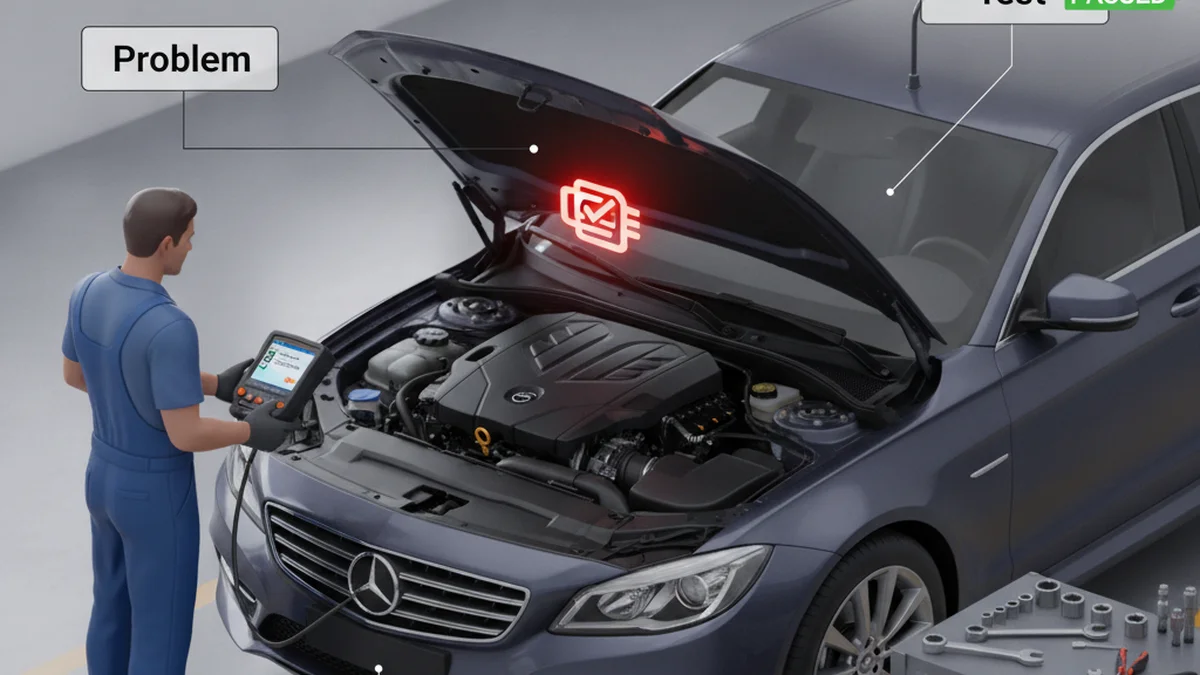
This national standard, which remains fully active in 2026, dictates that the MIL must be functioning but unlit, with all emissions readiness monitors completed, to pass..
Our vehicles continuously monitor their own exhaust systems to ensure greenhouse gases remain within legal limits. If the computer detects a deviation, it stores a diagnostic trouble code and lights up your dashboard.
Scanners Detect Unresolved Fault Codes
Testing technicians use specialized hardware that scans your vehicle’s engine control unit. Even if your car runs smoothly, any stored active fault code triggers an instant rejection.
We cannot hide these issues because the scanner pulls the exact alphanumeric code directly from your vehicle’s memory. This is why many drivers who failed emissions because check engine light alerts were active must seek a proper diagnosis.
Inspectors Follow Strict State Mandates
Inspectors must adhere to strict state environmental mandates that require an automatic failure for active warnings. These laws prevent vehicles from releasing excessive pollutants into the atmosphere.
You must resolve the underlying mechanical issue to clear the code permanently. We will now look at why trying to bypass this scanning process with a simple code reset fails. Attempting to bypass this by erasing the code only triggers another roadblock: OBD2 readiness monitors.
How Do OBD2 Readiness Monitors Block Simple Resets
Many drivers attempt to turn off their dashboard warning light with a scanning tool only to realize the testing machine instantly flags the change.
-
Clearing Codes Erases System Memory
Resetting your computer with an OBD2 scanner deletes all stored diagnostic trouble codes. This action also completely wipes your engine control module’s operational memory.
The car forgets its baseline data, forcing the computer to re-evaluate every sensor. Drivers asking will clearing codes pass inspection must realize the system detects this blank slate immediately.
-
Incomplete Monitors Trigger Automatic Rejection
Clearing your codes resets your system’s emissions readiness monitors to an incomplete state. Most states allow only one incomplete readiness monitor for 2001 and newer vehicles, according to the California Bureau of Automotive Repair According to the California Bureau of Automotive Repair’s Smog Check Manual, an illuminated Mal-Indicator Light (MIL), commonly known as the check engine light, is an automatic failure condition during the On-Board Diagnostic (OBD) portion of the state emissions inspection (bar.ca.gov, 2025 Smog Check Reference Guide)..
The emission station’s computer will automatically reject your vehicle if too many monitors read “not ready.” This safety feature prevents drivers from cheating the test by simply resetting their dashboard lights.
-
Pending Codes Restart the Warning Cycle
Your car continuously runs background tests while you drive on the road. If the original mechanical problem still exists, the system flags a pending code.
The check engine light will illuminate again before you can complete the testing process. To transition these monitors back to a passed status without triggering the warning light, you must execute a precise driving protocol.
How to Complete a Drive Cycle in 5 Steps
Setting your readiness monitors requires completing a specific drive cycle designed to simulate various road conditions.
-
Start Your Engine From Cold
Let your vehicle sit overnight so the engine coolant temperature drops below 122 degrees Fahrenheit. Start the engine and let it idle for two to three minutes with your rear defroster and air conditioner turned on.
This step applies an electrical load to the alternator. This load helps start the diagnostic testing sequence for your internal engine sensors.
-
Drive at Steady Highway Speeds
Merge onto a highway and maintain a steady speed of 55 miles per hour for 15 minutes To reset OBD-II readiness monitors for emissions testing, a standard drive cycle requires idling a cold engine for 2.5 minutes with accessories on, accelerating to 55 mph and maintaining that speed for 3 minutes, and then cruising at 55 to 60 mph for 5 minutes to evaluate the catalytic converter.
According to the U.S. Environmental Protection Agency (epa.gov, EPA OBD Frequently Asked Questions), these specific speed and time steps are critical to transition emission monitors from ‘Not Ready’ to ‘Ready’ after a battery disconnect or code clear.. Ensure you keep your throttle input as steady as possible to let the oxygen sensor monitor run.
Avoid using cruise control during this process, as manual throttle control is necessary for some manufacturer systems. This step is a crucial component of the obd2 readiness monitors drive cycle.
-
Decelerate Without Using the Brakes
Find a safe, long stretch of road where you can decelerate naturally without pressing your brake pedal. Let your vehicle coast down from 55 miles per hour to 20 miles per hour According to General Motors’ official OBD-II drive cycle guidelines, the vehicle must undergo a coastdown deceleration from 55 mph to 20 mph without braking or engaging the clutch, a step requiring approximately 20 to 25 seconds of continuous deceleration to successfully reset the EGR and EVAP system monitors (gmupfitter.com)..
This allows the computer to evaluate your exhaust gas recirculation system. This deceleration pattern tells the computer that your sensors are responding properly to changes in engine vacuum.
-
Idle Your Vehicle in Traffic
Drive in stop-and-go city traffic for approximately 10 minutes to test your evaporative emission systems. Stop at several traffic lights and let the engine idle in gear for at least 30 seconds during each stop.
This simulates standard daily commuting patterns. It allows your fuel tank pressure sensors to complete their necessary diagnostic sweeps.
-
Verify Your Readiness Monitor Status
Connect an inexpensive diagnostic tool to verify your progress. Ensure all essential monitors show a “ready” status before driving to your local state testing facility.
Learning how to pass emissions check engine light issues legally requires this final verification step. If your vehicle fails to set these monitors or if the dashboard light returns immediately during this drive, you may qualify for specific legal exceptions.
5 Legal Exceptions That Allow Cars to Pass
While compliance is strict, state environmental agencies design pathways for vehicle owners who face specific mechanical or financial hurdles.
Driving Older Carbureted Vehicles
If your vehicle was manufactured before 1996, it does not use the standardized OBD2 protocol. These older carbureted models are often exempt from computer scans and undergo different tailpipe tests.
You can often pass the inspection even if your dashboard warning light is illuminated, provided your physical exhaust tailpipe emissions fall within legal parameters.
Securing State Financial Waivers
Many states offer financial waivers if you spend a specific minimum amount on emissions repairs by a certified technician. This emissions waiver cost limit varies by region.
The typical spending limit ranges from $150 to $450 depending on your state and vehicle age, as outlined by Environmental Protection Agency guidelines Under the U.S. Environmental Protection Agency (EPA) guidelines updated for 2025, vehicle owners who fail an OBD-II emissions test can apply for a repair waiver if they document a minimum expenditure of $450 on emissions-related repairs (epa.gov, ‘Vehicle Emissions Inspection and Maintenance (I/M) Program Clean Air Act Requirements’).
This waiver temporarily allows vehicle registration renewal even if the check engine light remains illuminated, provided the repairs were diagnosed and performed by a certified technician..
Obtaining Temporary Registration Extensions
You can apply for a temporary registration extension if you fail your initial test near your expiration date.
These extensions grant you an extra 30 to 60 days to complete repairs and return for testing. This provides vital breathing room for budget-constrained commuters.
Living in Safety Only Districts
Some geographic regions within your state do not require emissions testing for vehicle registration. If you move to these safety-only inspection districts, you only need to pass a mechanical safety check.
Your vehicle will not undergo an OBD2 diagnostic scan during safety-only inspections. However, we always recommend keeping your engine in good working order.
Applying for Low Income Assistance
Several states manage economic hardship programs designed for low-income drivers facing high repair costs.
These programs can provide financial grants to help repair your vehicle’s exhaust components. Understanding these options can save you hundreds of dollars before you decide to seek professional mechanical support. Resetting those stubborn sensors requires executing a specific, multi-step drive cycle on the road. When driving endless miles fails to clear the system, certain legal exceptions might still save you.
If none of these loopholes apply, it is time to invest in professional diagnostic repairs.
When to Repair Your Check Engine Light
Knowing when to stop clearing codes and consult a licensed diagnostic technician can prevent severe engine damage.
Ignoring Flashing Check Engine Lights
A flashing dashboard warning indicates a severe engine misfire that can rapidly melt your catalytic converter According to the U.S. Environmental Protection Agency (EPA) OBD-II technical guidelines outlined in 40 CFR § 86.1806-17, a flashing Malfunction Indicator Light (MIL) indicates a severe engine misfire capable of causing immediate catalytic converter damage due to unburned fuel entering the exhaust stream.
The EPA warns that continuing to drive under these conditions can destroy the catalyst within miles, causing emissions to exceed federal limits by up to 1.5 times the standard (epa.gov, EPA OBD-II Regulations, 2025)..
We advise you to pull over immediately and tow your vehicle to prevent thousands of dollars in exhaust system damage. Operating a vehicle with a flashing warning light is incredibly dangerous.
Failing Multiple Drive Cycle Attempts
If your check engine light illuminates immediately after you perform a drive cycle, you have an active mechanical fault.
We recommend seeking professional diagnostics because your car cannot self-correct these electronic failures. A certified mechanic can target the precise sensor causing the issue.
Approaching State Registration Deadlines
Do not wait until the day your registration expires to address your emission problems.
Allowing yourself at least two weeks before your deadline gives you ample time to perform repairs and complete the required drive cycles. Let us resolve some of the most common questions regarding dashboard warning lights and state emission tests.
How to Manage Your Next Steps Legally
Getting your vehicle registered when dealing with mechanical issues can feel incredibly overwhelming. We know how frustrating it is to wonder if you can pass emissions with check engine light on during a stressful work week.
The most reliable path forward is to identify the root cause using a diagnostic tool rather than relying on temporary quick fixes. By systematically performing a drive cycle or exploring state waiver programs, you can keep your vehicle compliant in 2026 without breaking your budget.
Take action today by scanning your computer codes so you can plan your next steps with complete confidence.
Why Does a Check Engine Light Fail Emissions
Will Clearing My Trouble Codes With a Scanner Allow Me to Pass Emissions?
No, clearing your trouble codes will not allow you to pass inspection. When you reset your system, the emissions testing equipment instantly flags your readiness monitors as incomplete. You must drive your vehicle under specific conditions to reset these internal monitors before you can successfully pass the test.
How Long Do I Need to Drive After Resetting My Check Engine Light?
You typically need to drive between 50 and 100 miles over the course of several days to complete a full drive cycle. This combined distance allows your vehicle’s engine control module to perform all its necessary diagnostic checks on your emissions control systems.
Can I Get an Emissions Waiver If I Cannot Afford Repairs?
Yes, you can qualify for an emissions waiver if your repair costs exceed your state’s financial threshold. Many states require you to spend between $150 and $450 on emissions-related repairs at a certified facility before they will grant a temporary waiver.
Do Cars Built Before 1996 Get Tested for Check Engine Lights?
No, vehicles built before 1996 are generally exempt from standard OBD2 diagnostic scans. These older cars utilize OBD1 technology or carburetors, meaning inspectors will use tailpipe test probes or simple visual inspections rather than scanning for dashboard warning codes.
Can You Pass Emissions With the Check Engine Light on If It Is a Gas Cap Issue?
No, you cannot pass the test even if the warning light is only caused by a loose gas cap. The diagnostic computer still registers an active fault code within your evaporative emissions system, which triggers an automatic failure at the testing station.