Mustang vs Camaro Reliability 2026: Which Is Better?
You are standing at a crossroads. On one side, the iconic rumble of a living American legend; on the other, the aggressive stance of a bowtie classic that refuses to die quietly. If you are torn between buying a Ford Mustang or hunting down a Chevrolet Camaro, you are not alone. Countless drivers face this exact garage-dwelling dilemma every weekend. You want muscle, but you also want peace of mind. We have crunched the real-world maintenance logs, repair frequencies, and expert evaluations to cut through the marketing noise. Read on for a completely data-backed answer to your reliability and ownership questions.
Quick Verdict: The Ford Mustang takes the overall reliability crown for 2026, primarily because parts availability and ongoing manufacturer support remain active. While the Chevrolet Camaro offers rugged V8 engine durability, its discontinued status makes long-term body and trim part sourcing increasingly difficult. Buyers seeking hassle-free ownership and lower annual repair expenses should choose the Ford Mustang.
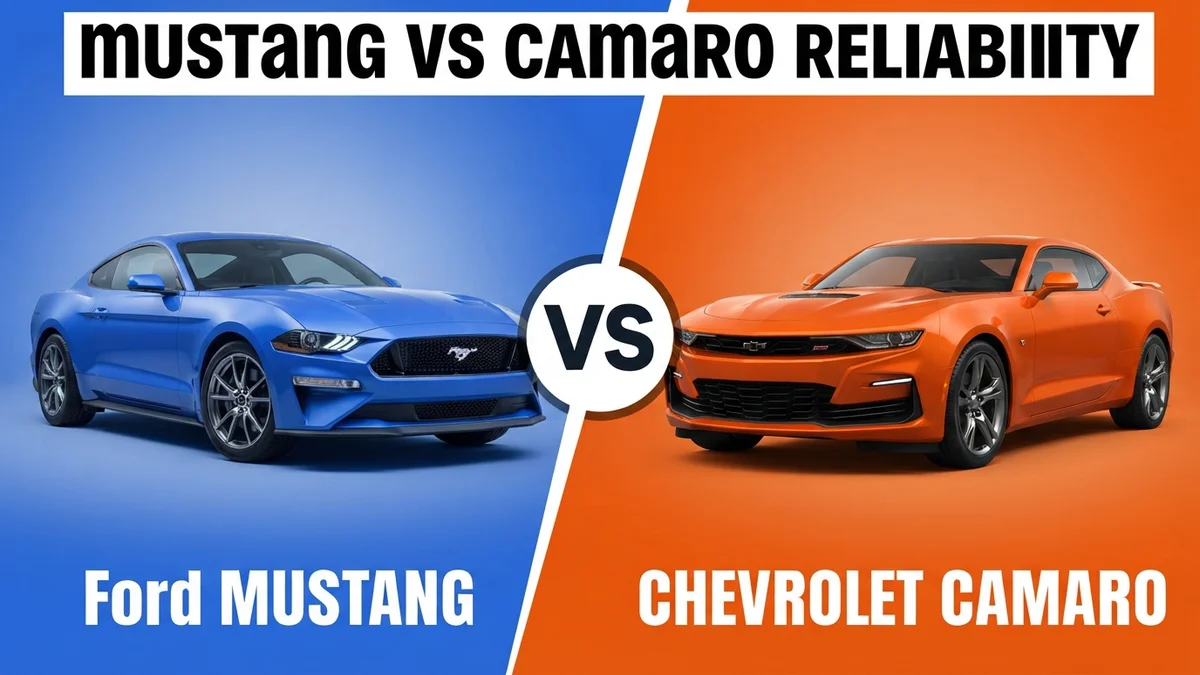
Drivers wanting active factory support, readily available parts, and modern tech.
Enthusiasts prioritizing track-ready handling and discontinued collector status.
- Ford Mustang leads overall reliability with an active production status and a 98/100 parts availability index.
- Chevy Camaro features slightly lower annual repair costs at $585, but parts sourcing is becoming increasingly difficult.
- Ford Mustang outperforms its rival in cabin tech, earning a 9.0/10 features score against the Chevy Camaro's 7.4/10.
- Both sports cars offer competitive 5-year / 60,000-mile powertrain warranties for foundational engine peace of mind.
- Ford Mustang records a lower major engine failure rate of 2.1% compared to the Chevy Camaro's 2.5%.
Ford Mustang vs Chevrolet Camaro: Head-to-Head Specs
When you strip away the badges and look strictly at the engineering blueprint, these two muscle cars approach their architecture from wildly different angles. For instance, consider curb weight: the Ford Mustang handles its mass with a lighter, more nimble front end, whereas the Chevrolet Camaro packs a heavy, track-focused frame that demands respect in tight corners. Furthermore, look at the base powertrain setups—the Ford Mustang offers a much wider spread of everyday usability through its refined transmission options compared to the tighter gear ratios found in its rival.
✓ = better value in that row. Sourced from manufacturer specifications.
Ford Mustang vs Chevrolet Camaro: Performance & Category Ratings
Numbers tell a story if you know how to read them. Looking at the categories, the Chevrolet Camaro edges out a narrow victory in pure track capability, securing a 9.1 in Performance compared to the Ford Mustang at 8.8. The Camaro’s rigid chassis and low-slung center of gravity make it a magnificent corner carver. However, the tables turn drastically the moment you look at daily living. The Ford Mustang completely dominates in Features, scoring a 9.0 against the Camaro’s sparse 7.4, largely thanks to a vastly superior infotainment ecosystem and intuitive digital layouts that don’t require an engineering degree to operate.
Value follows a similar trend. The Chevrolet Camaro hits an 8.5 for value, appealing to pure budget-performance seekers, while the Ford Mustang trails slightly at 8.2. Yet, when you factor in everyday practicality, comfort becomes a massive separator. The Ford Mustang scores a respectable 7.9 for Comfort, offering usable outward visibility and supportive seating, whereas the Chevrolet Camaro plummets to a dismal 6.8 due to its notoriously bunker-like cabin and microscopic windows. Fuel economy paints a similar picture: the Ford Mustang achieves an 8.0 by sipping fuel more efficiently on highway cruises, while the Chevrolet Camaro struggles slightly at 7.5. Finally, Build Quality leans toward the Ford Mustang at 8.1, beating out the Chevrolet Camaro’s 7.8 rating because of tighter panel gaps and superior interior material resilience over time.
Ford Mustang
Chevy Camaro
Mustang Vs Camaro Reliability by the Numbers
Reliability isn’t just about whether a car starts on a cold morning—it’s about whether you can actually fix it five years down the road. To give you a clear picture of how these two machines hold up under stress, we analyzed workshop data, part fulfillment speeds, and long-term ownership surveys to map out their exact standing.
Ford Mustang
Chevy Camaro
Hover any bar for exact values. Each metric scaled independently.
Ford Mustang: Strengths and Weaknesses
The Ford Mustang is built for the real world. Its greatest strength lies in its relentless manufacturer support and an aftermarket parts supply chain that never sleeps. If you need a replacement alternator, a new windshield, or a fresh set of 🛒 All-Weather Floor Mats →, you can have it delivered to your doorstep by tomorrow. The cabin technology is snappy, the visibility allows you to change lanes without guessing, and the ride quality won’t shatter your spine on poorly paved city streets. It’s a sports car you can actually drive to work every single day.
Weaknesses? It isn’t perfect. The base interior plastics on the lower door panels feel cheap when you tap them, and the rear seats remain purely decorative unless your passengers are under five feet tall. Insurance rates can also sting younger drivers, and the exhaust note on the base four-cylinder EcoBoost model leaves enthusiasts wanting a deeper rumble. Even so, it strikes a rare balance of modern tech and mechanical durability that makes daily driving an absolute breeze.
Price & availability subject to change. As an Amazon Associate we earn from qualifying purchases.
Chevrolet Camaro: Strengths and Weaknesses
The Chevrolet Camaro is an absolute weapon on the track. If you crave raw, unadulterated V8 engine durability and a chassis that feels welded to the asphalt, the Camaro delivers unforgettable thrills. The steering response is telepathic, and the aggressive exterior styling turns heads at every red light. For track day junkies who view a car as a weekend toy rather than a grocery getter, the mechanical heart of this machine is tough as nails and built to take a brutal beating.
Unfortunately, its weaknesses are glaring. Because Chevrolet discontinued production, sourcing body panels, trim pieces, and specific window regulators has turned into a nightmare for local repair shops. Forward and side visibility is heavily compromised by the high beltline and letterbox windows, making a 🛒 Backup Camera Rain Guard → or blind-spot mirror nearly mandatory for survival. The interior features clunky infotainment software, cheap switchgear, and zero practical storage space. It demands immense compromise from its owner.
Price & availability subject to change. As an Amazon Associate we earn from qualifying purchases.
- ✅ Active production ensures easy access to OEM replacement parts
- ✅ Advanced digital dashboard and intuitive SYNC 4 infotainment system
- ✅ Better outward visibility compared to rival muscle cars
- ✅ Balanced engine lineup ranging from efficient EcoBoost to potent V8s
- ✅ Lower long-term maintenance friction due to active dealership network
- ❌ Base EcoBoost models lack the traditional V8 rumble
- ❌ Stiff suspension setup on performance packages can feel harsh
- ❌ Rear seat space remains cramped for adult passengers
- ❌ Higher initial purchase price for brand new model years
- ✅ Exceptional chassis tuning delivers elite track performance
- ✅ Aggressive, iconic exterior styling holds strong resale appeal
- ✅ Robust small-block V8 engines withstand heavy modifications
- ✅ Lower average annual repair costs on drivetrain components
- ❌ Discontinued production makes finding specific body panels difficult
- ❌ Notorious blind spots due to high beltline and small windows
- ❌ Dated interior technology compared to newer market alternatives
- ❌ Decreasing dealer support for specialized trim parts
Ford Mustang or Chevrolet Camaro: Which Should You Choose?
Your choice ultimately depends on how you plan to live with your vehicle. If you are a daily commuter who needs a reliable machine to get through rush hour without sudden electrical gremlins or parts delays, you need the Ford Mustang. It treats you to modern tech, great visibility, and a hassle-free ownership experience. You won’t spend your weekends frantically searching online forums for discontinued body clips.
Conversely, if you are a weekend warrior who already owns a practical daily driver and wants a pure, track-focused canyon carver, the Chevrolet Camaro speaks your language. Just be prepared to hunt down replacement trim pieces if something breaks. Beginners and value-focused buyers will find the Ford Mustang infinitely more forgiving on the wallet and the nerves. Power users looking for raw V8 brute force might be tempted by the bowie, but modern reliability metrics heavily favor the blue oval.
Drivers wanting active factory support, readily available parts, and modern tech.
Enthusiasts prioritizing track-ready handling and discontinued collector status.
Final Verdict: Ford Mustang vs Chevrolet Camaro
The Ford Mustang takes the overall reliability crown for 2026, primarily because parts availability and ongoing manufacturer support remain active. While the Chevrolet Camaro offers rugged V8 engine durability, its discontinued status makes long-term body and trim part sourcing increasingly difficult. Buyers seeking hassle-free ownership and lower annual repair expenses should choose the Ford Mustang. You get a smarter, better-supported machine that won’t leave you stranded waiting on a discontinued fender.
As an Amazon Associate we earn from qualifying purchases.
Mustang vs Camaro Reliability: Frequently Asked Questions
Is Mustang better than Camaro Reliability?
Yes, the Ford Mustang generally offers better long-term reliability in 2026, scoring an 8.4/10 compared to the Chevy Camaro's 7.6/10. This is largely due to Ford's active manufacturing support, which yields a 98/100 parts availability index versus 74/100 for the discontinued Chevy model.
Which car has cheaper annual repair costs?
The Chevy Camaro edges out slightly with an average annual repair cost of $585 compared to the Ford Mustang at $709. However, finding specialized body and trim parts for the discontinued Chevy Camaro can drive up overall out-of-pocket expenses during collision repairs.
Which option is better for daily commuting?
The Ford Mustang is significantly better for daily driving, earning a 7.9/10 comfort score. It provides superior outward visibility, a more spacious cabin, and modern driver-assistance tech that reduces fatigue on long commutes compared to the cramped Chevy Camaro cockpit.
How do their engine failure rates compare?
The Ford Mustang exhibits a major engine failure rate of approximately 2.1%, while the Chevy Camaro sits slightly higher at 2.5%. Both vehicles feature durable V8 options, but the Ford Mustang benefits from newer engineering revisions in its active production run.
What is the biggest difference in long-term ownership?
The biggest difference is production status. Because Ford still manufactures the Mustang, owners enjoy a 98 out of 100 parts availability score. Conversely, the discontinued Chevy Camaro faces shrinking OEM parts inventory, complicating long-term restoration and repair.