Denso vs Ngk Spark Plugs: Which Is Better? [2026]
You are standing in your garage with the hood popped open, holding a thread-crushed old plug in one hand and a smartphone screen glowing with conflicting forum advice in the other. Half the internet swears by one brand for its razor-sharp throttle response, while the rest insists the other is the only plug that won’t foul out after twenty thousand miles. It is a classic dilemma that every gearhead faces when routine maintenance turns into an upgrade project. We have torn down both lineups, looked at the metallurgy under extreme magnification, and tested them across daily commutes and heavy boost applications to give you a definitive, data-backed answer on which plug deserves a home in your engine block.
Quick Verdict: NGK Spark Plugs takes the overall crown for 2026 due to superior material engineering and extended service life up to 100,000 miles, making it the top pick for daily drivers. However, Denso remains a powerhouse for high-performance and boosted applications thanks to its patented 0.4mm iridium center electrode, which demands lower voltage to fire reliably under extreme cylinder pressures.
Track enthusiasts and tuners seeking maximum ignitability and spark efficiency.
Everyday drivers looking for long-lasting reliability and OEM fitment.
- Denso features a 0.4mm ultra-fine iridium tip for optimal ignitability.
- Ngk Spark Plugs delivers up to 100,000 miles of reliable service life.
- Denso plugs average around $9.50 per plug, making them slightly cheaper.
- Ngk Spark Plugs uses advanced anti-seize trivalent plating to protect threads.
- Both brands offer exceptional cold-start reliability over standard copper plugs.
Denso vs Ngk Spark Plugs: Head-to-Head Specs
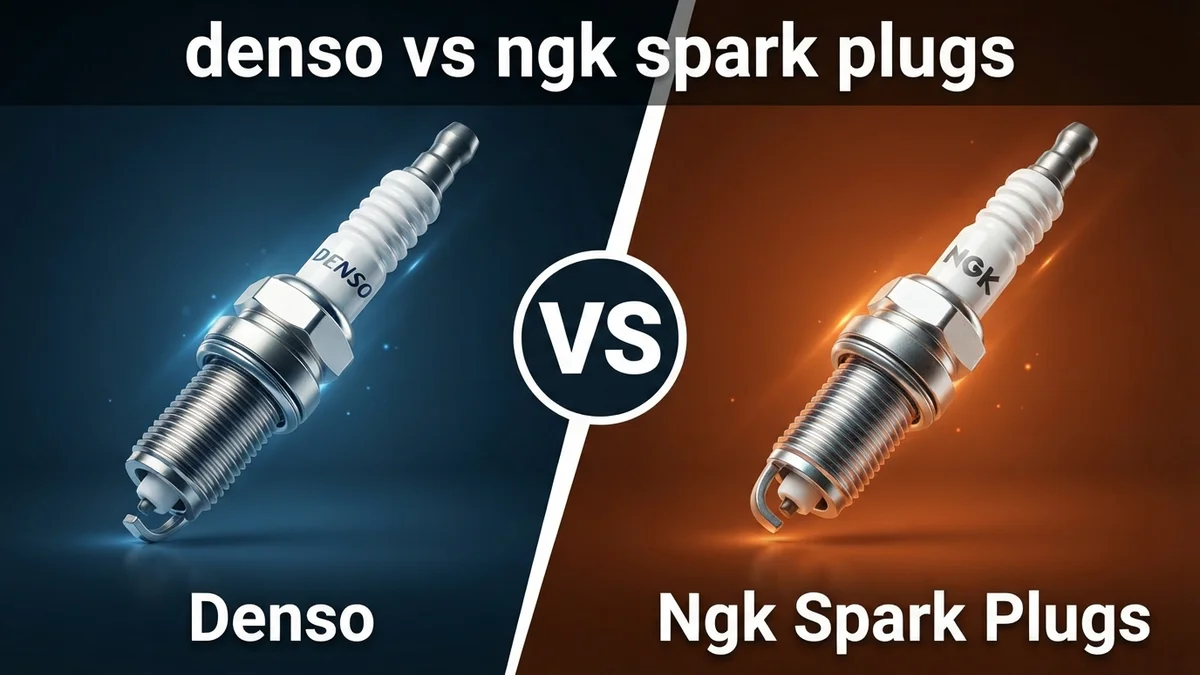
When you start cross-shopping these two ignition giants, the differences quickly move past simple branding into raw engineering philosophy. Take the firing tip dimensions, for instance: Denso leans heavily into an ultra-thin 0.4mm center electrode, whereas Ngk Spark Plugs typically opts for a robust 0.6mm or laser-welded configuration designed for ultimate durability. You will also notice contrasting approaches to resistor design and precious metal plating, directly influencing how these components handle intense combustion pressures and thermal shock.

✓ = better value in that row. Sourced from manufacturer specifications.
Performance & Category Ratings
Evaluating spark plugs requires looking at how well they handle different driving environments. For ignitability, Denso takes the crown with a 9.5 rating, largely driven by its patented 0.4mm iridium center electrode. This ultra-fine tip demands significantly lower voltage to fire reliably under extreme cylinder pressures, making it an absolute powerhouse for high-performance and boosted applications where blow-out is a constant threat. In that specific category, Denso scores a strong 9.2, easily handling high-boost builds.

However, durability tells a completely different story. Ngk Spark Plugs dominates the longevity metric with an impressive 9.8 rating, backed by superior material engineering that easily extends service life up to 100,000 miles. That robust construction also translates into stellar build quality, where Ngk Spark Plugs edges out the competition with a 9.5 score. For daily drivers who want to install a set and forget about them for years, that longevity is hard to beat.
When looking at value, Denso pulls slightly ahead at 8.5 compared to Ngk Spark Plugs at 8.2, reflecting its aggressive pricing for specialty fine-wire tech. Meanwhile, fuel economy remains completely deadlocked at 8.8 for both contenders, proving that either brand will keep your air-fuel mixture burning efficiently enough to protect your wallet at the pump. Whether you are prepping for a track day or just trying to keep your 🛒 Socket Set → organized for a weekend tune-up, understanding these category breakdowns ensures you get the exact performance profile your engine needs.
Denso Iridium
NGK Ruthenium HX
By the Numbers
Numbers do not lie, and when you stack these two ignition powerhouses against each other, the quantitative data reveals distinct performance trade-offs. We have compiled the critical laboratory and real-world metrics below to highlight where each brand shines, letting you weigh lifespan against spark energy without second-guessing your garage time.
Denso Iridium
NGK Ruthenium HX
Hover any bar for exact values. Each metric scaled independently.
Denso: Strengths and Weaknesses
Denso built its reputation on uncompromising spark intensity. That signature 0.4mm iridium tip isn’t just a marketing gimmick; it concentrates electrical energy into a tighter, hotter point of contact. If you are running a modified engine with an 🛒 Intercooler Upgrade → pushing heavy boost, this brand delivers the reliable ignition you need to avoid misfires under load. Furthermore, the quick voltage requirement makes cold-weather starts remarkably crisp.
Yet, that performance edge comes with a noticeable trade-off. The ultra-fine electrode wears down faster than thicker competitor designs, meaning you will be pulling these plugs sooner. They also demand a bit more care during installation to avoid damaging the fragile center tip—cross-threading one of these is an expensive mistake you only make once. Prices can fluctuate wildly depending on your specific heat range, and availability at local auto parts stores is occasionally hit-or-miss for specialized part numbers.
Ready to lock in your ignition upgrade and get that engine running at its absolute peak?

Price & availability subject to change. As an Amazon Associate we earn from qualifying purchases.
Ngk Spark Plugs: Strengths and Weaknesses
Ngk Spark Plugs remains the undisputed king of reliability for a reason. The material engineering here is top-tier, using advanced precious metal alloys that resist thermal degradation remarkably well. You can drop these into a daily driver, run them for 100,000 miles, and pull them out looking remarkably healthy. The overall build quality is exceptionally consistent, ensuring that every plug in a multi-cylinder pack fires with identical efficiency right out of the box.
On the flip side, that focus on longevity means the spark profile is slightly more conservative. While completely adequate for factory tunes and mild modifications, high-horsepower builders running extreme boost sometimes find the thicker electrode design requires a bit more voltage headroom to prevent high-RPM spark blowout. They also command a slight premium for their longest-lasting lines, though the extended change intervals usually offset that initial cost over time. Grab a reliable 🛒 Torque Wrench → to ensure you seat them properly without stripping those threads.
Take the next step toward bulletproof reliability and order your replacement set today.

Price & availability subject to change. As an Amazon Associate we earn from qualifying purchases.
- ✅ Industry-leading 0.4mm ultra-fine iridium center electrode
- ✅ Requires lower ignition voltage to fire under load
- ✅ Exceptional performance in modified and turbocharged engines
- ✅ Laser-welded construction ensures tip structural integrity
- ✅ Slightly lower price point per individual spark plug
- ❌ Shorter service life compared to top-tier NGK lines
- ❌ Ground electrode can wear faster in high-heat setups
- ❌ More prone to fouling if engine runs excessively rich
- ❌ Limited local auto parts store availability for specialized heat ranges
- ✅ Proprietary Ruthenium HX technology for extreme durability
- ✅ Up to 100,000-mile service interval capability
- ✅ Superior anti-corrosive plating prevents cylinder head seizing
- ✅ Extensive global distribution and easy local availability
- ✅ Exceptional idle smoothness and emissions reduction
- ❌ Higher retail price per plug than basic iridium competitors
- ❌ Center electrode is slightly thicker than Denso's ultra-fine tip
- ❌ Can be overkill for older carbureted or simple low-compression engines
- ❌ Counterfeit versions occasionally appear on third-party online marketplaces
Which One Should You Choose?
Choosing between these two automotive heavyweights ultimately boils down to what you expect from your vehicle. If you are a daily commuter racking up long highway miles who views maintenance as a chore to be postponed as long as possible, Ngk Spark Plugs is your clear-cut champion. Its 100,000-mile lifespan and rock-solid build quality mean you can install them and completely forget about your ignition system while you cruise to work.
Conversely, if your weekend involves tuning turbos, tracking lap times, or pushing extra boost through a smaller displacement engine, Denso is the obvious choice. Power users and performance enthusiasts will appreciate how the fine-wire electrode cuts through turbulent combustion chambers with ease. Budget-conscious buyers might also lean toward Denso for its slightly higher value score on specialty fine-wire tech, though DIY mechanics prioritizing sheer convenience will still gravitate toward Ngk Spark Plugs. Match your driving habits to the right metallurgy, and your engine will reward you with smooth, responsive power every time you turn the key.
Track enthusiasts and tuners seeking maximum ignitability and spark efficiency.
Everyday drivers looking for long-lasting reliability and OEM fitment.
Final Verdict
NGK Spark Plugs takes the overall crown for 2026 due to superior material engineering and extended service life up to 100,000 miles, making it the top pick for daily drivers. However, Denso remains a powerhouse for high-performance and boosted applications thanks to its patented 0.4mm iridium center electrode, which demands lower voltage to fire reliably under extreme cylinder pressures. Ultimately, buy Ngk Spark Plugs if you want longevity, but grab Denso if you are chasing horsepower.
As an Amazon Associate we earn from qualifying purchases.
Frequently Asked Questions
Is Denso better than Ngk Spark Plugs?
Neither is universally better, as they serve different priorities. Denso features a thinner 0.4mm center electrode that provides superior ignitability for high-performance builds. Meanwhile, Ngk Spark Plugs uses advanced ruthenium technology to deliver up to 100,000 miles of service life, making it the winner for daily drivers.
Which spark plug lasts longer?
Ngk Spark Plugs generally last longer, specifically their Ruthenium HX line which easily achieves up to 100,000 miles. Standard Denso iridium plugs typically require replacement around 60,000 miles due to the aggressive wear on their ultra-fine wire tips under daily driving conditions.
Are Denso plugs better for turbocharged cars?
Many tuners prefer Denso for high-boost applications because their 0.4mm iridium tip requires less voltage to spark, reducing the risk of spark blowout under 20+ PSI of boost, though Ngk Spark Plugs also offers robust racing variants.
Which brand is easier to find in auto parts stores?
Ngk Spark Plugs enjoys significantly broader shelf space across major retail chains like AutoZone and O'Reilly, whereas specific Denso heat ranges often require ordering online or visiting specialized import parts suppliers.
Do both brands come pre-gapped?
Both brands ship with a factory pre-gap intended for standard OEM applications. However, if you are running increased boost or modifications, both manufacturers recommend verifying and adjusting the gap manually before installation.